Tuesday, 10 June 2025

H.P. Arun Kumar and Ors. Vs. Addanki Haresh (RP) - It can be seen that the Appellant has not even endeavoured to establish the defence he has mounted that it was a transaction made in normal course of business and that it would be falling under the exceptions contemplated under Section 43(3) of the I & B Code, 2016.

 NCLAT (2025.03.06) in H.P. Arun Kumar and Ors. Vs. Addanki Haresh (RP), [(2025) ibclaw.in 173 NCLAT, Company Appeal (AT) (CH) (Ins) No. 184/2022] held that; 

  • It can be seen that the Appellant has not even endeavoured to establish the defence he has mounted that it was a transaction made in normal course of business and that it would be falling under the exceptions contemplated under Section 43(3) of the I & B Code, 2016. 

  • The Appellant cannot take the advantage of his own wrong by his failure to discharge his responsibilities as statutorily envisaged under Section 101 of the Evidence Act.


Excerpts of the order;

The question, which would be the subject matter of consideration in the instant Company Appeal preferred under section 61 of the Insolvency and Bankruptcy Code, 2016 would be, “As to whether, the identified two preferential transactions as per the report of Committee of Creditors of 09.11.2020, would fall to be a preferential transaction so as to be within the ambit of Section 43 of the I & B Code, 2016”.


# 2. The grievance, which has caused the Appellants to prefer this appeal, was as to the consequence of passing of an order on IA No. 482/2020, which was preferred by Respondent No.1, invoking Section 43 of I & B Code, 2016, contending thereof that two transactions, which is apparent from the draft Forensic Audit report of 09.11.2020 amounting to Rs.81.33 lakhs and Rs.78.81 lakhs, were ultimately found to be preferential and fraudulent transaction respectively. Upon establishment of the said fact the Impugned Order dated 02.02.2022 was passed by the learned NCLT, Bengaluru, in Company Petition (IB) No. 320/BB/2019, wherein while allowing the IA No.482/2020 the learned Adjudicating Authority had directed the Appellant No. 1 to restore an amount of Rs.24,29,874/- (Rupees Twenty Four Lakh Twenty Nine Thousand and Eight Hundred and Seventy Four) Appellant No. 2 to restore Rs. 25,53,233/- (Rupees Twenty Five Lakh Fifty Three Thousand and Two hundred and Thirty Three) and Appellant No. 3 to restore Rs.11,50,000/- (Rupees Eleven Lakh and Fifty Thousand) which were found to be classified as preferential transactions, and since being hit by the provisions contained under Section 43 of the I & B Code, 2016. The said directions of Ld. Adjudicating Authority are extracted hereunder: –

  • “i. The subject transactions are declared as Preferential Transactions in terms of Section 43 of the I & B Code, 2016.

  • ii. The Respondent No.1 is directed to restore an amount of Rs.24,29,874/- (Rupees Twenty Four Lakhs Twenty Nine Thousand Eight Hundred and Seventy Four only) to the Corporate Debtor within 30 days from the date of receipt of this order.

  • iii. The Respondent No.2 is directed to restore an amount of Rs.25,53,233/- (Rupees Twenty Five Lakhs Fifty Three Thousand Two Hundred and Thirty Three only) to the Corporate Debtor within 30 days from the date of receipt of this order.

  • iv. The Respondent No.3 is directed to restore an amount of Rs.11,50,000/- (Rupees Eleven Lakhs Fifty Thousand only) to the Corporate Debtor within 30 days from the date of receipt of this order.”


# 3. Before we attempt to venture to consider the rival contentions of the parties to the proceedings, it will be apt to observe that the Company Appeal stood initiated before the Registry of this Appellate Tribunal on 03.05.2022. The Appeal was accompanied with it, an IA No.421/2022, wherein the Appellant has prayed for, an exemption from filing the certified copy of the Impugned Order, as mandated by Rule 22(2) of the NCLAT Rules, 2016, which prescribes that “every appeal has to be accompanied with a certified copy of the Impugned Order under challenge”. The said Application thus preferred, seeking exemption from filing a certified copy remained pending and no endeavour was made by the Appellant ever, to press upon the appeal to override the implications of Rule 22(2) of the NCLAT Rules, 2016, and thus, the appeal would be treated to have been preferred without supplying the certified copy of the Impugned order. But owing to the fact that, the statute under the I & B Code, 2016, and particularly that as contained under the rules, as framed under Section 469 of the Companies Act, 2013, provides for a complete exemption from filing the certified copy of a document as contemplated under Rule 31 of the NCLAT Rules, 2016, we grant an exemption to the Appellant from producing the certified copy of the Impugned Order and proceed to hear, the Appeal on merits. Accordingly, IA No. 421/2022 would be treated to have been disposed of.


# 4. The brief facts on the merits of the matter are, that the Corporate Debtor (CD) M/s. Right Engineers and Equipment India Private Limited, are said to have availed financial assistance from M/s. Sir. M. Vishveshwaraya Co-operative Bank Limited (hereinafter to be called as a Financial Creditor). At the stage when the financial assistance was extended on 17.10.2016, Appellant No. 1 and Appellant No. 2 were the Directors of the Corporate Debtor, and Appellant No. 3 had the status of being that of wife of Appellant No.2. In the proceedings of CIRP, stood initiated against the CD, factually it had come up that, the Financial Creditor had extended a financial assistance of Rs.14,80,00,000 (Rupees Fourteen Crore and Eighty Lakhs) by virtue of a loan agreement which was executed on 17.10.2016, and under the terms of the loan agreement, the said financial assistance was extended for the purposes to facilitate the Corporate Debtor to augment and expand the business of manufacturing, designing, assembly & import and to generally deal with all kind of machinery, equipment, tools, moulds and automation products for all kind of users, and also to act as a consultant and as a manufacturer of cranes.


# 5. For the purposes of taking the financial assistance under the loan agreement of 17.10.2016, the Corporate Debtor is said to have encumbered plant and machinery, furniture and fixtures, and other equipment in the form of Hypothecation deed and had mortgaged the factory land and building, which was situated at No. 66 Jigani Industrial area, 1st Phase, Bangalore, with the total land thus mortgaged being 43,087 sq.ft with a built-up area of 28,838 sq.ft, shown to be standing in the name of the company as per the revenue records, are in the name of the company. The said mortgage was created by the surrender of the title deeds of the aforesaid land, which stood as a guarantee for the purposes of availing financial assistance under the agreement of 17.10.2016. The Corporate Debtor has also offered by way of a security, the stocks of the raw material, work in progress and the finished goods and all receivables in the form of Hypothecation.


# 6. The Corporate Debtor after being put into operation and after availing the aforesaid detailed financial assistance under the loan agreement of 17.10.2016, had felt a dearth of financial assistance, as the estimated construction cost of the project had exceeded the estimated cost under the plan and the generation of revenue, fell short, of expectation to make it a viable going concern. Hence the company i.e., the Corporate Debtor, in order to meet the expenses had to avail an additional financial assistance by way of term loan of Rs.10,40,00,000 (Rupees Ten Crore Forty Lakhs) and a secured cash credit of Rs.4,40,00,000 (Rupees Four Crore Forty Lakhs) in the month of October, 2016.


# 7. It is the case of the Corporate Debtor that, owing to the fact that there had been a business slump and economic downturn in the economy, of the country, he faced financial crunches and hence could not make repayments as scheduled under the terms of agreement for the amount of financial assistance taken on 17.10.2016 and, the additional term loan and secured cash credit taken on October 2016, in a timely manner. As a consequence thereto, the Financial Creditor had issued a repayment notice of the agreed installments as per the terms and conditions contained in the loan agreement of 17.10.2016, which was expected to be paid by the Appellant from time to time.


# 8. The Corporate Debtor and its erstwhile Directors i.e. the Appellant No. 1, 2, and Appellant No. 3 herein, had acceded and have accepted the fact that, they have committed a default and breach of loan agreement in remittance of the debt taken by them.


# 9. As a consequence of the aforesaid fact, the company was placed to face the CIRP Proceedings under Section 7 of I & B Code, 2016, initiated by the Financial Creditor and was ultimately admitted to the CIRP Proceedings by an order passed by the learned Adjudicating Authority on 29.10.2019. By the same order passed, on the same date, the learned Adjudicating Authority had appointed the Respondent herein, as to be an Interim Resolution Professional (IRP), in order to carry out the Resolution Process in respect of the Corporate Debtor, and while undertaking the said process and invitation of claims was made by the Respondent. The Respondent contends that, he had received a total claim due to be paid by the Corporate Debtor as to be Rs.15,00,09,200 (Rupees Fifteen Crore Nine thousand and Two Hundred).


# 10. The Respondent had come up with the case before the learned Adjudicating Authority that, on receipt of the aforesaid claim, the Committee of Creditors(CoC) asked the Respondent to examine the details of the transactions, of the Corporate Debtor to find out whether there has had been any preferential transaction falling to be within the ambit of Section 43 of the I & B Code, 2016, which has been carried by the Corporate Debtor to bypass the CIRP process, and whether there has been any transaction which has been maliciously carried by the Corporate Debtor to drain out the resources of the CD by undervaluation of the property as contemplated under Section 45 of the I & B Code, 2016 and also to flag any such other various flagrant transactions committed by the Corporate Debtor in order to facilitate successful conclusion of the CIRP Process.


# 11. The Committee of Creditors (CoC) met on 09.11.2020 for the purposes to deliberate upon as to whether there had been any of the transactions which had been carried by the Corporate Debtor, in violation of Sections 43, 45, 50 & 66 of the I&B Code, 2016, and in the same meeting, the Chartered Accountant who was appointed for this purpose submitted a draft report, with a detailed analysis of the Books of Accounts and the transactions which were carried by the Corporate Debtor. Based on the same, which the Respondent had ultimately arrived at a conclusion that there is a potential probability of a preferential transaction having been carried contrary to the provisions under Section 43 for an amount of Rs.81.33 lakhs and a potential fraudulent transaction under Section 66 for an amount of Rs.78.81 lakhs. It is on the basis of this report which has been submitted in compliance of the decision, taken in the Committee of Creditors (CoC) meeting on 09.11.2020, the Respondent is said to have filed an Interlocutory Application, being IA No. 482/2020, invoking the provisions contained under Section 43 of the I & B Code, 2016. The plea as raised in the aforesaid IA thus preferred by the Respondent, under Section 43 was based upon the final Forensic Audit Report dated 20.11.2020, which apparently showed that, there had been a flagrant violation of Section 43 and Section 66 of the I & B Code, 2016, as some of the identified transactions were found to be classified as preferential transaction with which we would be concerned in the instant appeal. In the report that was submitted on 20.11.2020, it was observed by the Chartered Accountant that, during the course of a Forensic Audit they, based on available material have identified some preferential transactions carried out and certain in non-compliances, which was apparent from the general review of the Financial Statements and Books of Accounts of the Corporate Debtor, and also based on the oral submissions and statement made by the management. The preferential transactions which were thus identified in the forensic report, were referred to in the document, which was annexed with the Forensic Audit Report, which contains the details of the transactions, as it was assessed to be for an amount of Rs.24,29,874 (Rupees Twenty Four Lakh Twenty Nine Thousand and Eight Hundred and Seventy Four). It is that during the course of the proceedings, while the learned Adjudicating Authority was considering the propriety of the allegations leveled in IA No. 482/2020, if had recorded the statements and objections, which were filed by the Appellant No. 1 & 2 and upon considering the aforesaid statement and objections, along with the additional affidavits and the reply of the 3rd Appellant, which was filed on 23.03.2021. After considering all these facts, the learned Adjudicating Authority by the Impugned Order of 02.02.2022 had proceeded to declare that some of the transactions, which were made in flagrant violation amount to be a preferential transaction under Section 43 of the I & B Code, 2016.


# 12. It is to be noted that in the IA thus preferred before Ld. Adjudicating Authority, the Respondent herein (the RP) had modulated the relief in the following manner:-

“a) Declare a payment of Rs.49.83 lakhs, constitutes as a preferential transaction violating Section 43 of the I&B Code, 2016.

b) Reverse the advance repayment transactions made to the respondents as detailed in Paragraph 8 above, and direct the amount of Rs.49.83 lakhs to be paid by the Corporate Debtor to the Respondent to be returned and vested in the Corporate Debtor.

c) Such other orders as this Appellate Tribunal may deem fit in the facts and circumstances of the case, in the interest of justice and equity.”


# 13. The Suspended Directors of the Corporate Debtor, who were opposite party no.1 & 2 in the proceedings before the learned Adjudicating Authority, had submitted their reply vide Diary No.1043 dated 23.03.2021, praying for that the application IA No.482/2020 preferred by the Respondent, has no legs to stand and the same deserves to be dismissed in limine because the elements provided under law for the purpose to determine a transaction as the preferential transaction under Section 43 of I & B Code, 2016, were not satisfied and thus the application deserves rejection. Upon the contest being put in by the Appellants herein, the Resolution Professional in order to override and to respond to the argument extended by the Appellants in their objection, had filed an additional affidavit on 08.11.2021, seeking to restore an amount of Rs.11,50,000 (Rupees Eleven Lakh and Fifty Thousand) against Appellant No. 3 in addition to the amount of Rs.49,83,107.90 (Rupees Forty Nine lakh Eighty Three Thousand and One Hundred and Seven and Ninety Paisa) as initially claimed against the Appellant No. 1 & 2 in IA No. 482/2020.


# 14. It was submitted by the Respondent before the Ld. Adjudicating Authority that on noticing certain related party transactions in the Audited Balance Sheet up to 2018, he had appointed M/s. Nagadheep Satyanarayana, the Chartered Accountant, and upon his resignation M/s. Hegdde Raj & Ullody, the Chartered Accountants, Bangalore to conduct forensic audit of the accounts and to review the accounts for a period of two years in the case of related parties, and for a period of one year in other cases before the commencement of the CIRP. The forensic audit report thus prepared was deliberated upon in the meeting of CoC on 09.11.2020 and based on such, IA was filed before the Ld. Adjudicating Authority for grant of reliefs as stated above.


# 15. The Ld. Adjudicating Authority after considering such audit report, giving ample opportunity to the Respondent to refute the report, after recording the statement of Mr. C M Nagaraj, one of the Suspended Directors of the company, the Appellant No. 2 herein, who had questioned the credibility of the Forensic Audit Report of 09.11.2020, after referring to the relevant portion of the said forensic report, which held certain transactions as to be the preferential transactions the details of which has been discussed in Para 7 of the Impugned order, after considering the statement and the stand taken by the Respondent/Liquidator who had submitted that the Appellant No. 1 & 2 have not re-paid the amount of Rs.49.83 lakhs, has concluded that classified the said amount is to be held as to be the preferential transaction made by the Corporate Debtor. Further, the learned Adjudicating Authority after considering the evidence on record, the stand of Appellant No.1 & 2 herein on the credibility of the Forensic Audit in view of the disclaimer clause, the original Forensic Audit Report of 09.11.2020 and the additional Audit Report dated 03.11.2021 had arrived at a conclusion that, the Appellants( Respondents in the Company Petition) had failed to substantiate their stand, and dispute the bank statement on which the Auditors had based their Forensic Audit Report and to repudiate the claim of CoC and the liquidator and therefore, the amount referred, thereto in IA No. 482/2020 which was subsequently modified by the Respondent herein, by making an addition to the amount to the tune of Rs.11,50,000 (Rupees Eleven Lakh Fifty Thousand), will have to be treated as preferential transactions. Further, the Ld. Adjudicating Authority had rightly came to the conclusion that the documents submitted by the Appellants herein did not substantiate that the claim made by them in their defence to IA No. 482/2020, that they have failed to show any valid document in support of this submissions except for taking a solitary stand, without placing any evidence on record, or any supporting documents, that the aforesaid transactions were carried by the Corporate Debtor in the ordinary course of business. Once the Appellants took a stand that the aforesaid two transactions identified to be preferential transactions, were actually carried during the ordinary course of business of the Corporate Debtor, the burden of proof under Section 101 of Evidence Act, to prove to the contrary, had shifted upon the Appellants to show that the transactions identified in the Forensic Audit Report, were not the transaction, which will be falling under Section 43 of the I & B Code. They having failed to do so, the conclusion, which has been arrived at by the learned Adjudicating Authority, declaring the transactions, as to be the preferential transactions and the consequentially directing Respondent No.1, Respondent No.2 and Respondent No.3 to the Company Petition to restore the amount of Rs.24,29,874/-, Rs.25,53,233/- and Rs.11,50,000 respectively correct in law, is contrary, to what has been attempted to be argued by the learned counsel for the Appellant based upon the grounds taken by them in the Memorandum of Appeal, to the effect that the findings which had been recorded are perverse and contrary to the record and based upon wrong appreciation of the statement and evidence, which was place by the Respondent and particularly the Forensic Audit Report of 09.11.2020 and the additional Forensic Audit Report of 03.11.2021.


# 16. The question of law which the learned counsel for the Appellants has attempted to argue before this Appellate Tribunal was from a very limited perspective, that, whether the learned Adjudicating Authority could have at all allowed the application under Section 43, without considering the objections filed by the Appellant and secondly, whether in the absence of the material particulars being placed before the learned Adjudicating Authority, it should have gone ahead to hold conclusively that the transactions were preferential transactions under Section 43 of the I & B Code. In fact, both the substantial questions, which have been pressed upon by the Appellant runs contrary to the finding, recorded by the learned Adjudicating Authority, who did consider the inferences drawn from the Forensic Audit Report and additional Forensic Audit Report, about the two transactions which were identified and found to be a preferential transactions and fraudulent transaction and they were established to have not been conducted during the normal course of business, which could not be prove to the contrary by the Appellant. In fact, in accordance with the findings recorded, it is seen that the Appellants have utterly failed to discharge their responsibility to establish their defence that the said two transactions were conducted during the ordinary course of business. Having failed to do so, they cannot take advantage of their own inaction that too, particularly when the findings have been recorded by the learned Adjudicating Authority was based upon the unrebutted Forensic Audit Reports and the additional Forensic Audit Report.


# 17. The second contention which has been raised by way of a substantial question was that, certain materials were not considered by the Ld. Adjudicating Authority while ruling the said transactions to be a preferential transaction, is contrary to the recording in the Impugned Order, wherein the learned Adjudicating Authority while extracting the relevant portion from the Audit Reports, has dealt in its Para 7 of the Order as to how the inferences on the preferential transactions have been drawn, which have been detailed based on the contents in the Forensic Audit Reports. This, read in consonance to the statements, recorded by the learned Adjudicating Authority as extracted in the concluding paragraphs of the Impugned Order will show that the Ld. Adjudicating Authority has considered all material placed before it. Thus the second question too is answered against the Appellant. Under Section 43 of the I & B Code, 2016, the basic parameters which are required to establish a transaction to be a preferential transaction, as envisaged under Section 43(1), is that the grounds as contemplated under Section 43(2)(a) and Section 43(2)(b) are to be satisfied which provides that, if there is any transfer or even a marginal transfer of interest by the Corporate Debtor, to the benefit of a creditor or a surety or a guarantor on account of an antecedent financial debt or operational debt or other liabilities owned by the Corporate Debtor and secondly, if such transfer under clause (a) has an effect of putting such creditor or surety or a guarantor in a beneficial position than it would have been in the event of a distribution of assests made in accordance with Section 53 of the Code, would be deemed to be a transaction, which is preferential in nature and having not been carried under normal course of business. In section 43(3) of the Code, certain exception have been provided.


# 18. The transactions, which have been detailed and determined by the Forensic Auditors in their report do not fall to be nor it was established to be falling under the exceptions as contemplated under Section 43(3) of I & B Code, 2016, and even on bare perusal of the observations, made in Para 7 of the Impugned Order under challenge, it can be seen that the Appellant has not even endeavoured to establish the defence he has mounted that it was a transaction made in normal course of business and that it would be falling under the exceptions contemplated under Section 43(3) of the I & B Code, 2016. The Appellant cannot take the advantage of his own wrong by his failure to discharge his responsibilities as statutorily envisaged under Section 101 of the Evidence Act. Since the Impugned Order is based upon a sound logical reasoning upon considering the statement and evidences on record, the observations made therein does not suffer from any perversity or misappreciation of evidence by the learned Adjudicating Authority which would call for any interference.


Hence, the Company Appeal (AT) (CH) (Ins) No.184/2022 lacks merit and the same is accordingly ‘dismissed’.


The Interlocutory Applications if any will also stand ‘closed’.

------------------------------------------

-


Monday, 9 June 2025

Kannan Sambasivam Vs. A V K Raja & Ors. - Based on the above findings and in the absence of the actual market value of the assets that were sold, this Tribunal holds that the liquidator has not provided sufficient proof to show that the impugned transaction has not taken place in the ordinary course of business of the CD.

 NCLT Chennai-1 (2025.05.30) in Kannan Sambasivam  Vs. A V K Raja & Ors.  [IA(IBC)/1777 (CHE)/ 2023 in IBA/355/2020] held that; 

  • That a mere suspicion upon the correctness of the invoice produced by an importer is not sufficient to reject it as evidence of the value of imported goods. The doubt held by the officer concerned has to be based on some material evidence and is not to be formed on a mere suspicion or speculation.

  • We may hasten to add that  although strict rules of evidence do not apply to adjudication proceedings under the Act, yet the Adjudicating Authority has to examine the probative value of the documents on which reliance is sought to be placed by the revenue.

  • It is well settled that the onus to prove undervaluation is on the  revenue and once the revenue discharges the burden of proof by producing contemporaneous imports at an evidence of higher price, the onus shifts to the importer to establish that the price indicated in the invoice relied upon by him is correct.

  • The asset purchase agreement between the beneficiary company and the CD is of dated 16.10.2019 is after the date of resignation, i.e 14.08.2019, of Respondent 4 and 5. Thus, on the date of alleged undervalued transaction, the Respondent 4 and 5 were not the directors of the CD. So, the CD and the beneficiary company cannot be held as related party.

  • In the present case, the CIRP commenced on 28.01.2021 and the alleged undervalued transaction was made on 16.10.2019, which was more than one year preceding the commencement of CIRP. It is already held that, the CD and the beneficiary company are not the related parties. That being the position, the alleged undervalue transaction would fall beyond the look back period of one year.

  • Based on the above findings and in the absence of the actual market value of the assets that were sold, this Tribunal holds that the liquidator has not provided sufficient proof to show that the impugned transaction has not taken place in the ordinary course of business of the CD. We are of the view that the impugned transaction does not meet the requirements of Section 45(2) to hold it as an undervalued transaction.


Excerpts of the order;

# 1. This is an application filed by the liquidator seeking the following reliefs: 

  • a. To declare the transactions as Under Valued Transactions which have been carried on with the intent to defraud the creditors of the corporate debtor, under the section 45 of the Insolvency and Bankruptcy Code, 2016 and make respondents liable to such contribution to the assets of the corporate debtor as it may deem fit and

  • b. To direct the respondents to return the amount of Rs.18.87 Crores, to the Liquidation estate of the corporate debtor and 

  • c. To pass such other orders as it deems fit in the above circumstances of the case and thus render justice.


# 2. It is stated that on an application filed under Section 7 of the Insolvency and Bankruptcy Code, 2016 ("Code") against Kapico Motors India Private Limited (hereinafter referred to as "Corporate Debtor"), this Tribunal passed  an order in IBA/355/2020 dated 28.01.2021, initiating CIRP against the Corporate Debtor and appointed the Applicant, Kannan Sambasivam as the Interim Resolution Professional (In brevity IRP) to carry out the functions mentioned under the Code.


# 3. It is stated that, since no Resolution plan was received during the CIRP period, the COC passed a resolution to liquidate the corporate debtor. Accordingly the resolution professional filed an application seeking liquidation of the corporate debtor. The tribunal passed an order for Liquidation of the corporate debtor in IA/324/2022 in IBA/355/2020 dated 28.04.2022 and appointed the Applicant herein as the Liquidator.


# 4. It is stated that, on scrutinizing the books of accounts for the financial years 2018-2019, 2019-2020 and 2020-2021, the applicant observed lot of financial deviations. The applicant conducted the 3rd Committee of the Creditors Meeting(CoC) on 4th Dec 2021 and brought to knowledge of the COC members about the financial deviations noticed in the books of accounts of the corporate debtor. It is stated that COC authorized the Applicant to appoint an auditor to conduct the Transaction audit of the books of accounts of the corporate debtor.


# 5. It is stated that, the applicant on 24.07.2021 appointed M/s QED Corporate Advisors LLP, to conduct the transaction audit to cover the PUFE transactions under Sections 43, 45, 50 and 66 of the IBC 2016. 6. It is stated that, the M/s QED Corporate Advisors LLP conducted the transaction audit of the financial statements for the FY 2017-18, FY 2018-19, FY 2019-20 and provisional unaudited statement of the FY 2020-21 and also te Tally ERP back for the period 01-04-2017 to 31-3-2020 (audited) and for the period 01-04-2020 to 31-03-2021 (unaudited) and submitted the Transaction Audit Report on 22.03.2023.


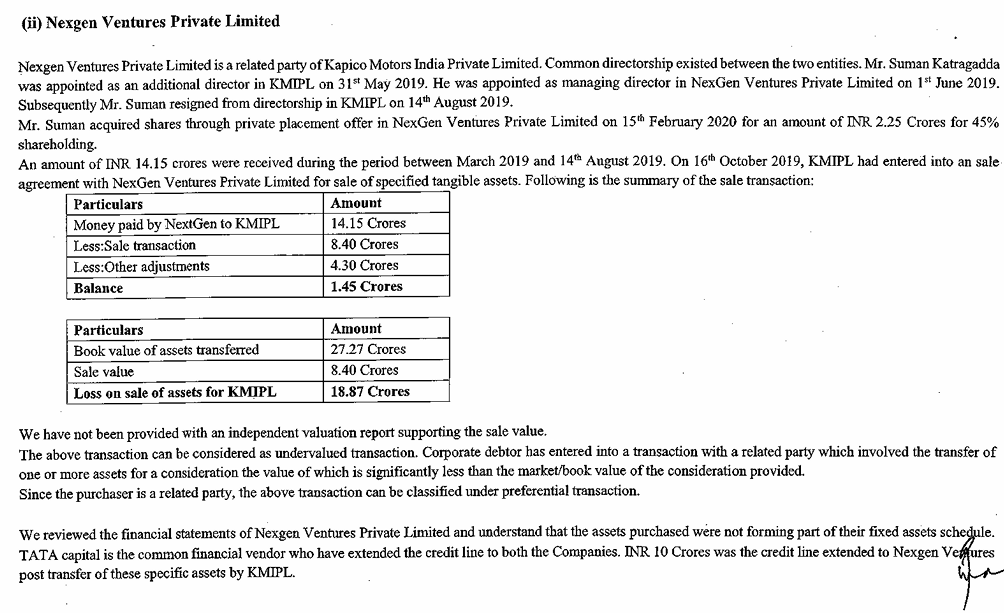
# 7. It is stated that, the Executive Summary of the Transaction Audit (4) (ii) reveals that the corporate debtor carried out an Undervalued Transaction to one of its related party company Nexgen Ventures Private Limited (hereinafter referred as beneficiary/nexgen) during the financial year 2019- 2020 qua the sale of the assets of the corporate debtor causing loss to the tune of Rs.18.87 Crores. The summary of the asset’s sale transactions is extracted below: 

For the Financial Year 2019-2020:

S. No.

Particulars

Amount in Crores


Money paid by NextGen to KMIPL

(Kapico Motors India Private Limited)

14.15 Crores


Less: Sale Transaction

8.40 Crores


Less: Other adjustments

4.30 Crores


Balance

1.45 Crores


S .No.

Particulars 

Amount in Crores


Book Value of the assets transferred 

27.27 Crores


Sale Value 

8.40 Crores


Loan on Sale of Assets for KMIPL

18.87 Crores


# 8. It is stated that, the 4th Respondent Mr. Suman Katragadda, who is currently one of the directors of the Nexgen Ventures Private Limited had joined as director in the board of the corporate debtor on 31/05/2019 and resigned from the board on 14/08/2019, He joined as director with the beneficiary company Nexgen Ventures Private limited on 01/06/2019.


# 9. It is stated that, 5th Respondent Mr. Mallikarjuna Rao Damacharla, who is currently the director in the Nexgen Ventures Private Limited, also joined as director in the board of the corporate debtor on 31/05/2019 and resigned on 14/08/2019. The Respondent No.5 was already on the board of the Nexgen Ventures Private limited as director since 17/03/2016 (As per MCA record). Form No DIR-12 for the appointment of R4 and R5 as the directors of the corporate debtor is enclosed as Annexure 4 and Form No DIR-12 qua resignation of the respondents R4 and R5 as directors of the corporate debtor is enclosed as Annexure 5.


# 10. It is stated that, the Corporate Debtor on 16/10/2019 had signed an Asset Purchase Agreement with the beneficiary for the sale of the assets of the corporate debtor to the value of Rs.8.40 Crores. The details of the corporate debtor's assets sold is given in the Annexure of the agreement. The agreement was signed on behalf of the corporate debtor by Mr. A V K Raja, Managing Director of the Corporate debtor and on behalf of the beneficiary by Mr. Mallikarjuna Rao Damacharla, the Managing Director of the beneficiary company.


# # 11. It is stated that, the details of the Fixed Assets as on 01/04/2019 and 31/03/2020 are enclosed as Annexure 7. The total value of the fixed assets as on 01/04/2019 is Rs.28.19 Crores and the total value of the fixed assets as on 31/03/2020 is Rs.85.04 Lakhs. Accordingly, total value of the fixed assets eroded during the FY 2019-2020 to Rs.27.34 Crores but as per the Asset Purchase Agreement dated 16/10/2019 the said fixed assets mentioned in the agreement were sold only for Rs.8.40 Crores.


# 12. It is stated that on scrutinising the Journal Entries, it was observed that following entries were made in the books of accounts as Sales to the beneficiary:


S. No.

Date of Journal Entries made in the books of accounts

Description of sale of assets made to the Nexgen

Value of the assets sold in Rs.


15/11/2019

Furniture 

18,45,678


15/11/2019

Computer

23,553


15/11/2019

Electrical Fittings

35,76,849


15/11/2019

Nexa

2,24,31,923


15/11/2019

Thirumullaivoyil 

5,99,15,624


15/11/2019

True Value

25,71,079


15/11/2019

CMBT

7 9,59,291


15/11/2019

Body Shop 

15,72,402


15/11/2019

TMVL Services

18,69,787

10.

15/11/2019

Tambaram

2,44,22,818

11. 

15/11/2019

Ambattur

1,36,49,168

12. 

15/11/2019

Warehouse 

11,61,828


Total

8.69,99,997


# 13. The beneficiary Ledger Account Statement for the period from 1/04/2018 to 31/03/2023 is enclosed as Annexure 8. It is stated that the  statement clearly states that all the financial transaction happened between the Corporate Debtor and the beneficiary company.


# 14. The bank statements of the corporate debtor with the State Bank of India for the period April 2019 to June 2019 and July 2019 to Sept 2019 are enclosed as Annexure 9 and Annexure 10 respectively. It is stated that the bank statements reveal that all the receivables and payment were made to the beneficiary company during the period April 2019 to Sept 2019. 


# 15. It is stated that the applicant mailed the draft copy of the Transaction Audit Report to the erstwhile directors on 06/02/2023 and sought for their clarification (Copy of the mail is enclosed herewith as Annexure 11) and the erstwhile directors sent a reply on 2/3/2023 (copy of their reply is enclosed as part of the Transaction Audit Report - Annexure 3).


# 16. It is stated that, the Audited Balance Sheet as on 31/3/2019 mentioned the value of the Fixed Assets as Rs.28,19,12,505 and the Audited Balance Sheet as on 31/3/2020 mentioned the value of the Fixed Assets as Rs.85,04,167. Accordingly, the value of the Fixed Assets eroded by Rs.27,34,08,338 during the FY 2019-2020, however as per the Asset Purchase Agreement dated 16/10/2019, the said fixed assets were sold for Rs.8.40 Crores only. Hence the corporate debtor with clear intention to defraud the creditors sold the Fixed Assets of the corporate debtor to the loss of Rs. 18.87 Crores and this transaction is clearly an Undervalued Transaction carried out by the corporate debtor to benefit the beneficiary company, Nexgen Ventures Private Limited.


# 17. It is stated that, since their responses did not clarify the queries raised in the draft transaction audit report, he has filed the instant application seeking the suitable remedies.


# 18. It is stated that, the above transaction was carried out with an intention to defraud the creditors of the corporate debtor and could potentially be classified as Under Valued Transactions as per Section 45 of the Insolvency and Bankruptcy Code, 2016.


COUNTER AFFIDAVIT ON BEHALF OF THE RESPONDENTS NO. 1, 2&3

# 19. The Respondent 1,2 & 3 filed a common reply and stated that, the COC in the meeting held on 04.12.2021 approved the appointment of the Transaction Auditor, namely QED Corporate Advisors LLP. As per Sections 25(1), 43 to 51 and 66 of the Code, its mandate was to investigate Avoidable Transactions involving the Corporate Debtor. The Transaction Auditor submitted its Report on 22.03.2023, highlighting certain irregularities in the Corporate Debtor's transactions. Based on the report, the Liquidator has filed this Application without independent opinion u/s 45 of the I&B Code read with Rule 11 of the NCLT Rules, 2016. Notably, without an independent opinion, no application under Section 45 is tenable before this Tribunal. 


# 20. It is stated that, in the executive summary of the Transaction Audit Report, the Corporate Debtor was alleged to have been involved in an undervalued transaction with a related party, Nexgen, during FY 2019-20. According to the report, this transaction led to a significant loss of Rs. 18.87 Crores, a "central issue" in this case.


# 21. It is stated that, the present application filed against the 5 erstwhile directors of the Corporate Debtor under Section 45 of the Insolvency and Bankruptcy Code, 2016 (I&B Code) is liable to be dismissed in limine being not maintainable as it seeks a relief which is not maintainable in law primarily on the following grounds:

  • a. This application is unsustainable due to non-joinder of proper parties and misjoinder of parties.

  • b. This application is unsustainable since the impugned transactions challenged therein were entered beyond the relevant period. It has been filed based on the misconceived fact that the beneficiary was related to the Corporate Debtor, alleging that the transaction was entered within the relevant period.

  • c. Claims are factually unsustainable because the transactions were not undervalued.


# 22. It is stated that, the application is liable to be dismissed because of nonjoinder of the necessary party, namely Nexgen Ventures Private Limited ("Nexgen" or "Beneficiary"), the beneficiary of the alleged undervalued transaction. This is a crucial legal argument that needs to be addressed. Further, the respondents have been wrongly and illegally arrayed as

respondents in the purported application.


# 23. It is stated that, the beneficiary was not a related party of the CD at any time, as alleged by the Applicant. The CD was in dire need of funds to meet various financial obligations, and therefore, it approached the beneficiary for funding, either in the form of an investment or a loan. Based on the arrangement, beneficiary provided financial support as and when the CD needed. The funding arrangement started in March 2019 and the funding was for Rs.14.15 Crores. The Board resolution of the CD to avail loan from the beneficiary for 20 crores is extracted here below:


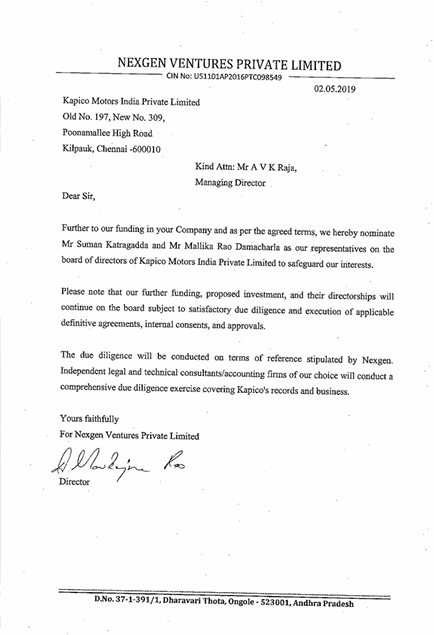
# 24. It is stated that, because of the said funding and to evince interest, beneficiary company nominated 4th and 5th Respondents as Directors of the CD w.e.f 31.05.2019 to ascertain the CD business's viability to take a call on investment and further funding. After considering the non-viability of the company's business, R4 and R5 resigned as Directors of the Company w.e.f 14.08.2019 within 3 months from the date of their appointment. It is stated that, they were never involved in the affairs of the CD. It is stated that R4, R5 and beneficiary never had any shareholding in the CD. The letter dated 02.05.2019 from the beneficiary appointing Respondent 4 & 5 is extracted below.

# 25. It is stated that, the Respondents wish to emphasise that neither R4 & R5 nor the beneficiary were related to the CD at any time. However, the Applicant misconstruced that the R4 and R5 were related to the Corporate Debtor: The above facts prove that R4, R5 and the Beneficiary were not associated with the CD as related party covered under any of the provisions of IBC. The relationship between them and CD was purely a Creditor-Debtor relationship; therefore, R4, R5 and Beneficiary were unrelated parties to the CD.


# 26. It is stated that, the funds received from the Beneficiary were utilised primarily to discharge the dues of the other financial creditors. It is stated that R1 settled the CD's significant dues from his sources and beneficiary; therefore, Nexgen became a vital lender of the CD. It is stated that R1 settled around Rs. 40 Crores with various financial creditors during pre-CIRP and post-CIRP. Therefore, no creditors lodged any claim with the Applicant during the liquidation period except GST Authorities and the PF department. 

# 27. It is stated that, since CD's business was unviable, beneficiary expressed its unwillingness to support further funding or investment and conveyed that it wants to start dealership business independently, thereby sought repayment of the loan extended to the CD. The Respondents explored all possible ways to prevent further liabilities from being incurred. The Respondents made a full enquiry into the Company's affairs and formed an opinion that the CD continuing the operations would result in further liability, and keeping the assets would also incur colossal expenditures.


# 28. It is stated that, in this backdrop, beneficiary showed its interest in purchasing the impugned assets subject to valuations. The CD and the beneficiary appointed their valuers, and based on the valuation reports given by the valuers, the price was fixed. The assets were transferred in consideration of dues of Rs.8.40 crores payable to the beneficiary. R1 gave his assets as security for the remaining dues payable by CD to the beneficiary. (copy of the Valuation Report issued by the registered valuer is enclosed and marked as ANNEXURE-R/6, copy of the Memorandum of Deposit of Title Deeds executed by R1 in favour of Nexgen is enclosed and marked as  ANNEXURE-R/7)


# 29. It is stated that for a transaction to come within Section 45 of the IBC, 2016: 

  • (a) there must be a "transaction"; 

  • (b) it has taken place within the "relevant period" within the meaning of s 46; and 

  • (c) it is an "undervalue" within the meaning of s 45 (2). In this case, the sale of the assets was a "transaction" that was entered on or about 16.10.2019, and CD was placed into CIRP on 28.01.2021.


# 30. It is stated that, beneficiary was not a related party to the CD, and any transactions within one year from the commencement date of CIRP, i.e., between 27.01.2020 and 28.01.2021, would be considered relevant. Moreover, as stated supra, R4 and R5 were the directors of the CD as nominated by Nexgen for only three months, from 31.05.2019 to 14.08.2019 and had mere debtor and creditor relationships not beyond that. In this case, the transaction was entered on 16.10.2019. i.e., beyond the "relevant period" and does not fall under Section 46 of the IBC, 2016.


# 31. It is stated that, the primary contention of the Applicant is that CD's fixed assets, as of 31.03.2019, having a book value of Rs. 28.19 Crores, were transferred to the beneficiary for Rs. 8.40 Crores on 16.10.2019, thereby it was an undervalued transaction that caused CD a loss of Rs. 18.87 Crores. In this connection, it is stated that the Book Value is not the correct measurement to ascertain the undervalued transactions covered under IBC, 2016. Book value is the net value of a CD's assets on its balance sheet, primarily based on the original acquisition cost of the respective assets after deduction of allowable depreciation. The market value of such assets would be based on their nature. If such assets are appreciable, the market value would be higher than the book value. If such assets are depreciable, the market value would be less than the book value. In the instant case, all assets were highly depreciable and not marketable.


# 32. It is stated that, to sell any assets, the Board of Directors, being commercial men, valued the assets only on a factual basis and not at cost or their value appearing in the books. It is stated that all the assets and liabilities must be taken at a fair value/market value, not merely at a book value. It is not always necessary to accept the book value. The actual test is to determine the fair value or the market value. The correct value is the market price or the cost price. The market price is more relevant since they were the used assets in this case. If the liquidator doubted the price at which the assets were sold, he should have ascertained the property's actual value. If the assets sold were less than the actual value, then the difference between the value arrived by the liquidator and the value of assets sold, should have been considered as undervalued. In this case, there was no such exercise on the part of the liquidator or the transaction auditor, and they relied on the value that appeared in the books.


# 33. It is stated that, the transaction auditor failed to understand the nature of assets sold and its marketability. Maruti Udyog Limited (MUL) had appointed the CD as an Authorised Dealer. To meet the criteria laid down by MUL, CD had to employ large number of staff to establish the showrooms and service stations as per MUL's mandate. The CD made huge investments and created fixed assets, including all showrooms in leased premises and maintained the showrooms spending crores of Rupees. The CD also raised loans worth crores of rupees from the banks and other financial lenders to fulfil the criteria and obligations laid down by the MUL. Due to heavy losses during 2019 on account of business crises, especially in the auto industry, the CD approached MUL to transfer the CD dealership to others to avoid further losses since maintenance of the showrooms and service stations involved huge expenses like rental, salary and other operating costs. It is stated that, the showrooms and service stations could not be used for any purpose other than the MUL dealership. It is stated that the CD duly apprised MUL of the reasons for heavy losses incurred by the CD vide its letter and email dated 26.07.2019 and 09.08.2019, respectively. (A copy of the letter and email dated 26.07.2019 and 09.08.2019 are enclosed and marked as ANNEXURE-R/8)


# 34. It is stated that, the sold assets comprised of 14 layouts structured according to specifications and design mandated by MUL. Though the book value of the assets is higher, they could not be sold by the CD without the concurrence of the MUL and there was no scope for purchase, by any parties other than the MUL dealers. Moreover, the transaction was based on the assessment and valuation made by the parties. The business loss was also duly claimed in the tax return filed for the relevant AY 2020-21, which the income tax department allowed. It is stated that, the sale consideration is driven by market forces, especially those willing to have a dealership similar to MUL. Further, current sale consideration was what a third-party buyer would be willing to pay based on proper valuation. Therefore, the same cannot be considered as undervalued transaction covered under the provisions of Section 49 of IBC. (A copy of the Tax Audit Report for the AY 2020-21 is enclosed and marked as ANNEXURE-R/10)


# 35. It is stated that, had the CD continued the business, it would have resulted in enormous future business losses. CD's decision to sell the showrooms and service stations in the ordinary business minimized any further losses due to CD's performance. It is stated that on these explanations, the Transaction Auditor and Liquidator should have considered and dropped the audit findings but, the transaction auditor observed mechanically and misconstrued that the transaction was undervalued.


# 36. It is stated that, assuming that the impugned transaction was entered within the relevant period without accepting the same, the only dispute is whether the Transactions were at an "undervalue" within s 45(2) of IBC, 2016. It is stated that the submission of the Applicant is that, the net book value of the assets, is significantly more than the sale value of the assets at the material time, however, there are no findings, opinions of the liquidator or the transaction auditor on the market value of the impugned assets at the material time.


# 37. It is stated that, assuming that the book value is an appropriate method to ascertain the actual value of the assets; then, valuation mandated under CIRP, or Liquidation becomes meaningless. For example, if a CD bought an immovable property for Rs. 10 Lakhs ten years back, it showed Rs. 10 lakhs as book value from the date of purchase to date, but it doesn't mean that the value of the said asset is still Rs.10 lakhs. The value of such assets would have been more than Rs. 10 Lakhs because immovable property is highly appreciable. This situation would be converse if the assets are depreciable, as in the instant case, the revalue of depreciable assets will depend upon usage, adaptability and market forces. It is stated that, though the book value of the impugned assets is higher, it is unsuitable for other car dealers, and only MUL dealers could use them. If any of the MUL dealers show no interest in buying the said assets, then the assets have no value at all. Under these circumstances, the CD had no alternative but to sell to Nexgen to settle their dues, which wanted to be the MUL dealer after getting proper valuations.


# 38. It is stated that, the Applicant's claim has no factual basis and Rs.8.40 Crores was provided by adjusting beneficiary’s financial debts for the Transaction. NexGen's consideration for the Transaction was not significantly less than the value of the assets since they were sold based on the valuation. Thus, the Transaction was not undervalue within Section 45 of IBC, 2016. 


# 39. It is stated that, the Application contains no pleading of fact showing the impugned assets' market value at the material time. It relies upon the book value, which does not represent the fair market value or market value of the impugned assets at the material time. Therefore, the pleadings do not disclose a reasonable cause of action for a claim based on Section 45. Moreover, the impugned assets were sold in the ordinary course of business based on the proper valuation report. Hence, the contention that they are undervalued is factually and legally unsustainable.


# 40. It is stated that, the purported application is solely based on a misconceived Transaction Report with false allegations. The genesis between the beneficiary and the Corporate Debtor and the impugned transactions is missing in the purported application and the transaction audit report.


COMMON COUNTER STATEMENT OF THE 4TH & 5TH RESPONDENT

# 41. Respondent 4th and 5th have filed their common reply and stated that, the application is neither maintainable in law nor on fact. It is stated that the application has been filed with unexplained delay and laches and is barred by limitation:


# 42. It is stated that, CIRP of the Corporate Debtor commenced on 28.01.2021 and the present Application has been filed on 05.10.2023 without any pleading or explanation for the undue delay in preferring the same.


# 43. It is stated that, the Regulation 35A of the Insolvency and Bankruptcy Board of India (Insolvency Resolution Process for Corporate substituted Persons) Regulations, by Notification No. 2016 as IBBI/2018-19/GN/REG031, dated 3rd July, 2018 (w.e.f. 04-07-2018), provides the timelines within which preferential and other transactions are to be determined and filed by the RP. The said Regulation is also reiterated in Regulation 40A that deals with the model time-line for corporate insolvency resolution process. The Hon'ble Supreme Court in Arcelormittal India (P) Ltd. v. Satish Kumar Gupta (2019)2 SCC 1 has emphasized the significance of the model timelines as provided in Reg 40A and stated that they are to be followed as closely as possible by all the authorities. The Applicant has severely flouted the timelines prescribed and the same has been captured in the following table: 


Event 

Latest timelines as per Regulations 35A and 40A

Timeline in the present

matter

Commencement of CIRP 

T

28.01.2021

RP to form opinion on

preferential and other

transactions

T+75 days 

Application filed on

05.10.2023 (T+ 980 days)

(Delay of 905 days)

RP to make

determination on

preferential and other

transactions

T+115 days

Application filed on

05.10.2023 (T+ 980 days)

(Delay of 865 days)

RP to file Applications

to AA for appropriate

relief

T+ 135 days

Application filed on

05.10.2023 (T+ 980 days)

(Delay of 845 days)


# 44. It is stated that, there is an unexplained delay of 845 days in preferring the Application and the Application is liable to be dismissed. 


# 45. It is stated that, as per the statutory mandate of the Code read with Regulation 35A, the RP ought to have formed an opinion whether the CD had been subjected to any transactions covered u/s 43, 45, 50 or 66 within 75 days of commencement of CIRP. If such an opinion was formed, the RP ought to have made a determination of the same within 115 days and ought to have filed the Application within 135 days from commencement date. The pleadings and documents of the Application under reply reveal that no such  opinion was formed, or determination was made prior to filing of the Application.


# 46. It is stated that, the Applicant failed to independently apply his mind and form an opinion or make a determination as mandated under law.


# 47. It is stated that, the NCLT Kolkata Jitendra Lohia vs. Nikhil Chowdhury and others [Ι.Α. (IB) No. 208/KB/2021INC.P (IB) No.204/KB/2019] has held as under:

  • "16. We have carefully seen the averments of the application and corresponding reply of the respondents. We have noticed that the allegations made in application do not constitute anything actionable against the respondents. It was the duty of the RP to come to conclusive determination before filing an application with the Adjudicating Authority. Simply by repeating the extracts or observations made in the forensic auditor's report, the RP could not make an  independent determination about the nature of transactions as required by Regulation 35A (2) of the CIRP Regulations."


48. The NCLT Kolkata (30.06.2022) in Kshitiz Chhawchharia vs. Madhumalati Merchandise Private Limited & Ors [I.A. (IB) No. 346/KB/2019 In CP (IB) No. 349/KB/2017) held that:

  • "6.8. Further, Regulation 35A(3) of the CIRP Regulations provides that upon making such determination under regulation Resolution 35A(2), the Professional shall apply to the Adjudicating Authority for the appropriate relief on or before the one hundred and thirty-fifth day of the insolvency commencement date. In this case, the one hundred and thirty fifth day is on 23 May 2018. The instant application being IA. (IBC) 346/KB/2019 has been filed on 20 March 2019, thus making it clear that the Applicant has not complied with the provisions of regulation 35A within the timeline provided therein.

  • 6.9. . . . . , we do not see any "determination" within the meaning of regulation 35A of the CIRP Regulations. Therefore, we will not act as court of first instance to determine the nature of the transactions mentioned hereinabove.

  • 6.1 In light of the above facts and circumstances, the adjudicating Authority is satisfied that the instant application is not maintainable and the same is therefore rejected."


# 49. It is stated that, the Applicant has filed this Application on assumptions and presumptions and solely on the transaction audit report. In Para 18 of the application the Applicant states, that since the responses did not clarify the queries raised in the transaction audit in the draft report, he has filed this application seeking suitable remedies. It is stated that the notices appear to have been sent only to the 1st to 3rd Respondents and not the answering Respondents.


# 50. It is stated that, without issuing a notice or seeking explanation from the Respondents, conclusions have been made. Neither the transactional auditor nor the Applicant called upon the Respondents to tender explanation. It is stated that, the said findings and procedure adopted by the Applicant are in gross violation of the principles of natural justice and equity.


# 51. It is stated that, this application is liable to be dismissed on primary ground of non-joinder of M/s. Nexgen Ventures Pvt. Ltd. It is stated that Nexgen Ventures Pvt. Ltd. is the only beneficiary of the alleged undervalued transaction and hence, would be a necessary party, without which, the proceedings cannot sustain.


# 52. It is stated that the 4th and 5th Respondents have been wrongfully arrayed in their individual capacity as Respondents in the Application. The inclusion of 4th and 5th Respondents, who are not relevant to the alleged undervalued transaction, constitutes misjoinder of parties.


# 53. It is stated that, the relationship between the CD and Nexgen Ventures Pvt. Ltd. was purely that of creditor and debtor. They were not the related parties as per the provisions of the IBC. The CD had resolved to borrow a loan of Rs.20,00,00,000/- from Nexgen Ventures Pvt. Ltd. and to issue warrants and fully convertible debentures. Nexgen Ventures Pvt. Ltd. provided financial support to the CD and initially lent Rs.14.15 Crores. Similarly, Nexgen Ventures Pvt. Ltd. also passed resolutions to lend to the CD.


# 54. It is stated that, 4th and 5th Respondents who were Directors in. Nexgen Ventures Pvt. Ltd., were appointed as directors of the CD on 31.05.2019 upon the nomination of Nexgen Ventures Pvt. Ltd. to assess the business viability of the CD for further potential investment. They resigned on 14.08.2019 after determining that further investment was not viable. Apart

from that, they had no involvement in the CD's transactions or decision making or management. It is stated that neither the answering Respondents nor Nexgen Ventures Pvt. Ltd. held any shares in the CD.


# 55. It is stated that, since the CD business was found unviable, Nexgen Ventures Pvt. Ltd. demanded repayment of the loan advanced to the CD. It was thereafter that both the parties appointed independent valuers and decided to sell the assets to Nexgen Ventures Pvt. Ltd. at the price of Rs.8.40 crores. It is stated that the 1st Respondent had also pledged his personal property with Nexgen Ventures Pvt. Ltd. for the balance dues of the CD, Nexgen Ventures Pvt. Ltd. did not pursue any claim with the CD for the balance amount.


# 56. It is stated that, the impugned transaction occurred on 16.10.2019, whereas the CIRP commenced on 28.01.2021. As per Section 46 of the IBC, the relevant period for reviewing transactions is one year before the commencement of CIRP for unrelated parties. Since Nexgen Ventures Pvt. Ltd. was not a related party, transactions between 27.01.2020 and 28.01.2021 are relevant. The transaction therefore falls outside the look back period.


# 57. It is stated that, the Audit report has several disclaimers and limitations whereby it was categorically admitted and stated among others that 

  • i) the findings cannot be taken to be exhaustive in view of the fact that only specific sample of transactions were reviewed and that it is possible that observations may have been different had the whole documentation/information were provided and reviewed on a particular matter; 

  • ii) The understanding observations of the merely represents facts and possible interpretations and that clients are advised to take expert opinion before initiating action; 

  • iii) We did not obtain third party confirmations directly from banks, vendors, customers, third parties, etc. for the transactions selected for review due to paucity of time, etc.


# 58. It is stated that, the Application has been filed invoking Section 45 the Code alleging undervalued transactions against the Respondents. It is well settled that in case such allegations are levelled, the burden of proving the same beyond reasonable doubt lies on the person levelling such allegations. In the present case, mere book entries cannot not prevail over the reports of the independent valuers.


# 59. The Hon'ble Supreme Court in Commissioner of Customs Vs. Aggarwal Industries Ltd.(2012)1 SCC 186 has held that a mere suspicion upon the correctness of the invoice produced by an importer is not sufficient to reject it as evidence of the value of imported goods. The doubt held by the officer concerned has to be based on some material evidence and is not to be formed on a mere suspicion or speculation. We may hasten to add that  although strict rules of evidence do not apply to adjudication proceedings under the Act, yet the Adjudicating Authority has to examine the probative value of the documents on which reliance is sought to be placed by the revenue. It is well settled that the onus to prove undervaluation is on the  revenue and once the revenue discharges the burden of proof by producing contemporaneous imports at an evidence of higher price, the onus shifts to the importer to establish that the price indicated in the invoice relied upon by him is correct.


FINDINGS AND OBSERVATIONS OF THIS TRIBUNAL

# 60. Heard the counsels for the parties and perused the documents. 


# 61. It is the case of the liquidator that, the CD made an undervalued transaction by entering into an asset purchase agreement dated 16.10.2019 with the beneficiary company. The asset purchase agreement provides for sale of fixed assets of the CD and the total sale consideration was 8,40,00,000/- (Eight Crore Forty Lakhs Only). It is further the case of liquidator that, the audited balance sheet as on 31/03/2019 mentions the value of the fixed assets as Rs.28,19,12,505/- and the audited balance sheet as on 31/03/2020 mentions the value of the fixed assets as Rs.85,04,167/-(Eighty Fife Lakhs Four Thousand  One Hundred Sixty Seven). Nonetheless, the asset purchase agreement signed between the CD and the beneficiary provides for the sale consideration to the tune of Rs.8.40 crores. Consequently, value of the fixed assets of the CD eroded to the extent of 18.87 crores.


# 62. The Liquidator appointed a transaction auditor, i.e., QED Corporate Advisors LLP, on 24.07.2021 to conduct the transaction audit of the CD. The transaction auditor subhmitted the final report on 22.03.2023 in which, the transaction auditor provided that, the transaction entered between the CD and the beneficiary company can be considered as an undervalued

transaction. The report also stated that, the beneficiary company is a related party to the CD as there were common directors in the companies. The extract of the report is provided here below:

# 63. The Respondent 1,2 and 3(suspended directors of CD) in their reply have stated that, the application is liable to be dismissed on the grounds of non-joinder of parties as the beneficiary company is not made as the party to the application. It was stated that, the CD and the beneficiary company are not the related parties and the application has been filed beyond the relevant period as provided in Section 46 of the Code. It was stated that, the nature of relation between the CD and the beneficiary is of creditor and debtor.


# 64. The Respondent 1,2 and 3 have stated that, the liquidator failed to consider the market value of the properties that were sold to the beneficiary company under the asset purchase agreement dated 16.10.2019. The liquidator  only considered the book value and the same does not show the actual value of the properties that were sold. The liquidator also failed to ascertain the actual value. The transaction audit report as well also failed to consider the actual value of the assets that were sold.


# 65. The Respondent 4 and 5 (currently the directors of the beneficiary company) reiterated the contention of the Respondent 1,2 and 3 and stated that, the relationship between the CD and the beneficiary is that of creditor and debtor and they are not the related parties. The liquidator failed to ascertain the actual value and did not prove the allegation of undervalue transaction beyond reasonable doubt. It was stated that, the Respondent 4 and 5 were appointed as directors from 31.05.2019 till 14.08.2019 and the asset purchase agreement was entered between the CD and beneficiary on 16.10.2019. Thus, there was no related party transaction.


# 66. Upon perusing the factual matrix, the following issues arise;

  • a. Whether the beneficiary is a related party to the CD and alleged undervalue transaction between the CD and the beneficiary falls within the look back period of 2 years as per Section 46(1)(ii) of the Code?

  • b. If the findings of the first issue is in affirmative, whether the liquidator has provided sufficient proof to prove that the CD entered into a transaction for a consideration the value of which is significantly less that the value of the consideration provided by the CD and such transaction has not taken place in the ordinary course of business of the CD?


# 67. It is seen that, the CD had taken financial assistance form the beneficiary which is also evidenced in the ledger statement provided along with the application. The Respondent 4 and 5 were appointed as directors of CD on 31.05.2019. They resigned from CD on 14.08.2019. The respondents in their reply have annexed the letter dated 02.05.2019 from the beneficiary company addressed to the CD, which states that the Respondent 4 and 5 were nominated by the beneficiary company as the representatives on the board of directors of CD to analyse the business viability of the CD. The letter dated 31.05.2019 states that, the beneficiary company withdraws the proposed investment and asked Respondent 4 and 5 to resign from the board of CD with immediate effect.


# 68. The asset purchase agreement between the beneficiary company and the CD is of dated 16.10.2019 is after the date of resignation, i.e 14.08.2019, of Respondent 4 and 5. Thus, on the date of alleged undervalued transaction, the Respondent 4 and 5 were not the directors of the CD. So, the CD and the beneficiary company cannot be held as related party.


# 69. It is relevant to extract Section 46 of the Code, which provides as under; 

  • 46. Relevant period for avoidable transactions. –

  • (1) In an application for avoiding a transaction at undervalue, the liquidator or the resolution professional, as the case may be, shall demonstrate that –

  • (i) such transaction was made with any person within the period of one year preceding the insolvency commencement date; or

  • (ii) such transaction was made with a related party within the period of two years preceding the insolvency commencement date.

  • (2) The Adjudicating Authority may require an independent expert to assess evidence relating to the value of the transactions mentioned in this section. 


# 70. The Section 46(1)(i) provides that, the liquidator must demonstrate that the undervalued transaction was made with any person within the period of one year preceding the date of commencement of CIRP. Section 46(1)(ii) provides that, in the case of related party, the transaction must have been made within two years preceding the date of commencement of CIRP. In the present case, the CIRP commenced on 28.01.2021 and the alleged undervalued transaction was made on 16.10.2019, which was more than one year preceding the commencement of CIRP. It is already held that, the CD and the beneficiary company are not the related parties. That being the position, the alleged undervalue transaction would fall beyond the look back period of one year.


# 71. The Section 45 provides as under;

  • 45. Avoidance of undervalued transactions. – 

  • (1) If the liquidator or the resolution professional, as the case may be, on an examination of the transactions of the corporate debtor referred to in subsection

  • (2) 1[***] determines that certain transactions were made during the relevant period under section 46, which were undervalued, he shall make an application to the Adjudicating Authority to declare such transactions as void and reverse the effect of such transaction in accordance with this Chapter.

  • (2) A transaction shall be considered undervalued where the corporate debtor–

  • (a) makes a gift to a person; or

  • b) enters into a transaction with a person which involves the transfer of one or more assets by the corporate debtor for a consideration the value of which is significantly less than the value of the consideration provided by the corporate debtor, and such transaction has not taken place in the ordinary course of business of the corporate debtor.


# 72. As per Section 45 (2) of the Code, a transaction is considered to be undervalued when the Corporate Debtor either makes a gift to a person or enters into a transaction with a person which involves the transfer of one or more assets by the Corporate Debtor for a consideration, the value of which is  significantly less than the value of the consideration provided by the Corporate Debtor, and such transaction has not taken place in the ordinary course of business of the Corporate Debtor.


# 73. In the present case, the audited financial statement as on 31.03.2019 provides the fixed assets value to be 28,19,12,505/-(Twenty Eight Crore Nineteen Lakhs Twelve Thousand Five Hundred Five Rupees), whereas, the audited financial statements as on 31.03.2022 provides the fixed assets value to be Rs. 85,04,167/- (Eighty Five lakhs Four Thousand One Hundred and Sixty Seven Thousand Rupees). The difference in the fixed assets value is around 27.27 crores and the sale consideration as per the assets purchase agreement between CD and the beneficiary is 8.40 crores. In the transaction audit report, the market value of the assets sold was not given. Further, there are no findings, opinions or pleadings of the liquidator on the market value of the impugned assets at the material time. We find substance in the contention of the Respondents that the book value is not the correct measurement to ascertain the undervalue transactions. The book value is the net value of the Corporate Debtor assets on its balance sheet primarily based on the original acquisition cost of the assets after deduction of allowable depreciation. Market value of such assets would be based on their nature. If the assets are appreciable, the market value would be higher than the book value and if the assets are depreciable, the market value would be less. In the instant case, the Corporate Debtor was appointed as the authorized dealer of Maruti Udyog Limited(MUL). It made huge investments and created fixed assets including showrooms. It raised the loans to create infrastructure for the showrooms. It suffered heavy losses due to business crisis in auto industries. This led to contact the beneficiary namely Nexgen. As per the agreement with MoU, the showrooms and service stations could not be used for any purpose other than specified by MoU. Although the book value of the assets were higher but the assets could not be sold without the concurrence of the MUL. There was no scope for purchase by any parties other than MUL dealers. The sale consideration was driven by market forces specially those willing to have a dealership. The beneficiary showed its interest and the parties appointed the valuers to arrive at the market value of the assets. Nothing can be made out from the above that the Corporate Debtor did the undervalue transactions with the beneficiary company Nexgen to drive benefit out of it rather the said transactions were made with Nexgen, not being the related party in the ordinary course of business to come out of the rigors of heavy losses suffered by the Corporate Debtor.


3 74. The Respondents in their reply have attached the valuation report.

  • a. The valuation report attached by the Respondent No 1,2 & 3 provides the valuation of the assets of CD as Rs.8,00,89,093/-. The report is extracted here below;

  • b. The valuation report attached by the Respondent No 4 & 5 dated 20.09.2019 provides the valuation of the assets of CD as Rs.8,14,28,921/-. The report is extracted here below


# 75. Based on the above findings and in the absence of the actual market value of the assets that were sold, this Tribunal holds that the liquidator has not provided sufficient proof to show that the impugned transaction has not taken place in the ordinary course of business of the CD. We are of the view that the impugned transaction does not meet the requirements of Section 45(2) to hold it as an undervalued transaction.


# 76. In the light of above discussions, we do not find any merits in the application qua declaring the transactions as undervalue transactions which have been carried on with an intent to defraud the creditors or to make the Respondents liable to such contributions to the assets or to direct the Respondents to return an amount of Rs. 18.87 Crores to the liquidation estate of the Corporate Debtor as prayed for.


# 77. We accordingly dismiss the application with no orders as to cost.

-------------------------------------------